History · 1871–1959
School History
Killinchy School, open from 1871 to 1959.
Killinchy Public School opened on 3 April 1871 and closed in 1959. For the school’s 150th anniversary in 2021, the Ellesmere Historical Society published a series of stories in The Ellesmere Echo — researched and written by Mike Noonan and Sandra Opie, alongside memories from former pupils and their families.
These stories are reproduced from the History of Killinchy School collection on Selwyn Stories (Selwyn Libraries), under a Creative Commons Attribution-NonCommercial 3.0 New Zealand licence. Our thanks to the Ellesmere Historical Society and the contributors.
The stories
 Opening of the first and second Killinchy Schools2021
 The 5th anniversary of the Killinchy School13 May 2021
 The O'Briens, one of the early families at Killinchy School27 May 2021
 Early treats and prizes at the Killinchy School10 June 2021
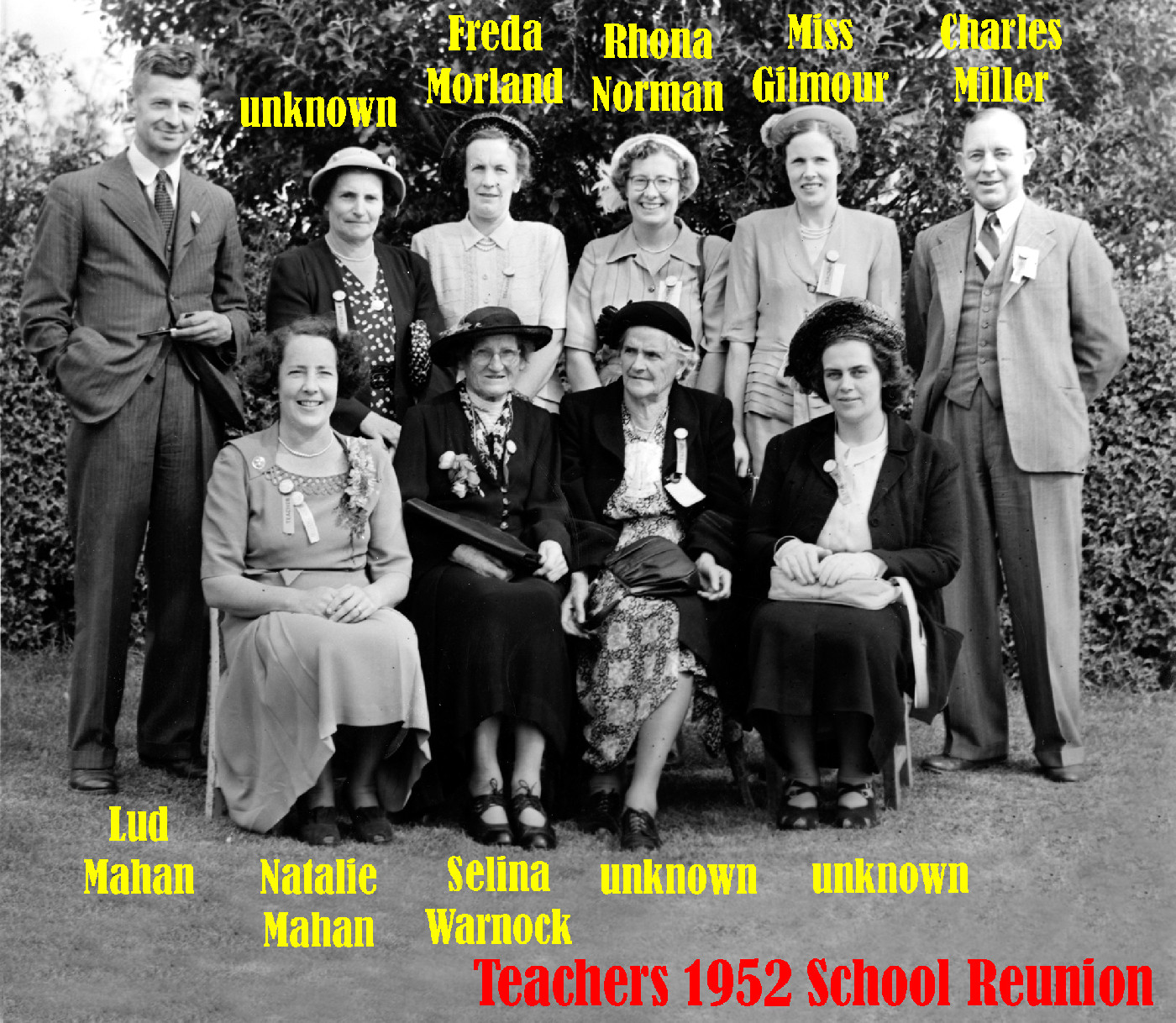 Staff, pupils and committee of the Killinchy School24 June 2021
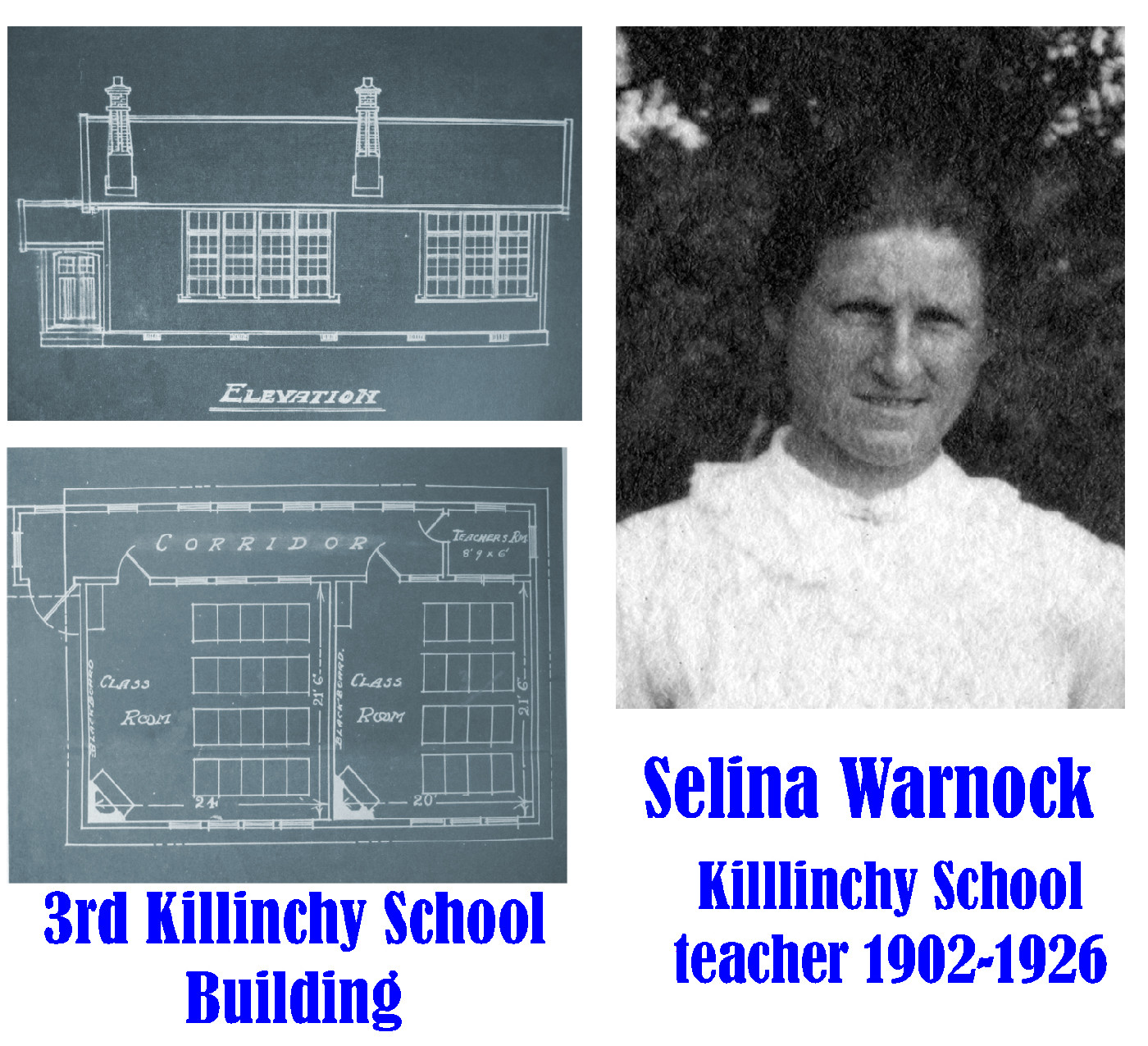 Killinchy School during the reign of Selina Warnock 1902-268 July 2021
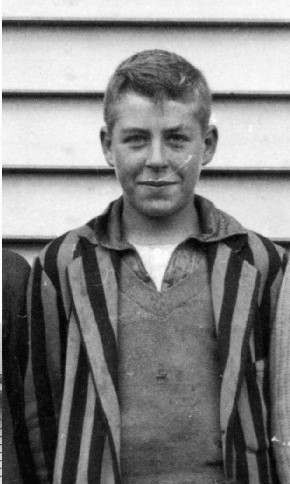 Stan Pycroft at Killinchy School22 July 2021
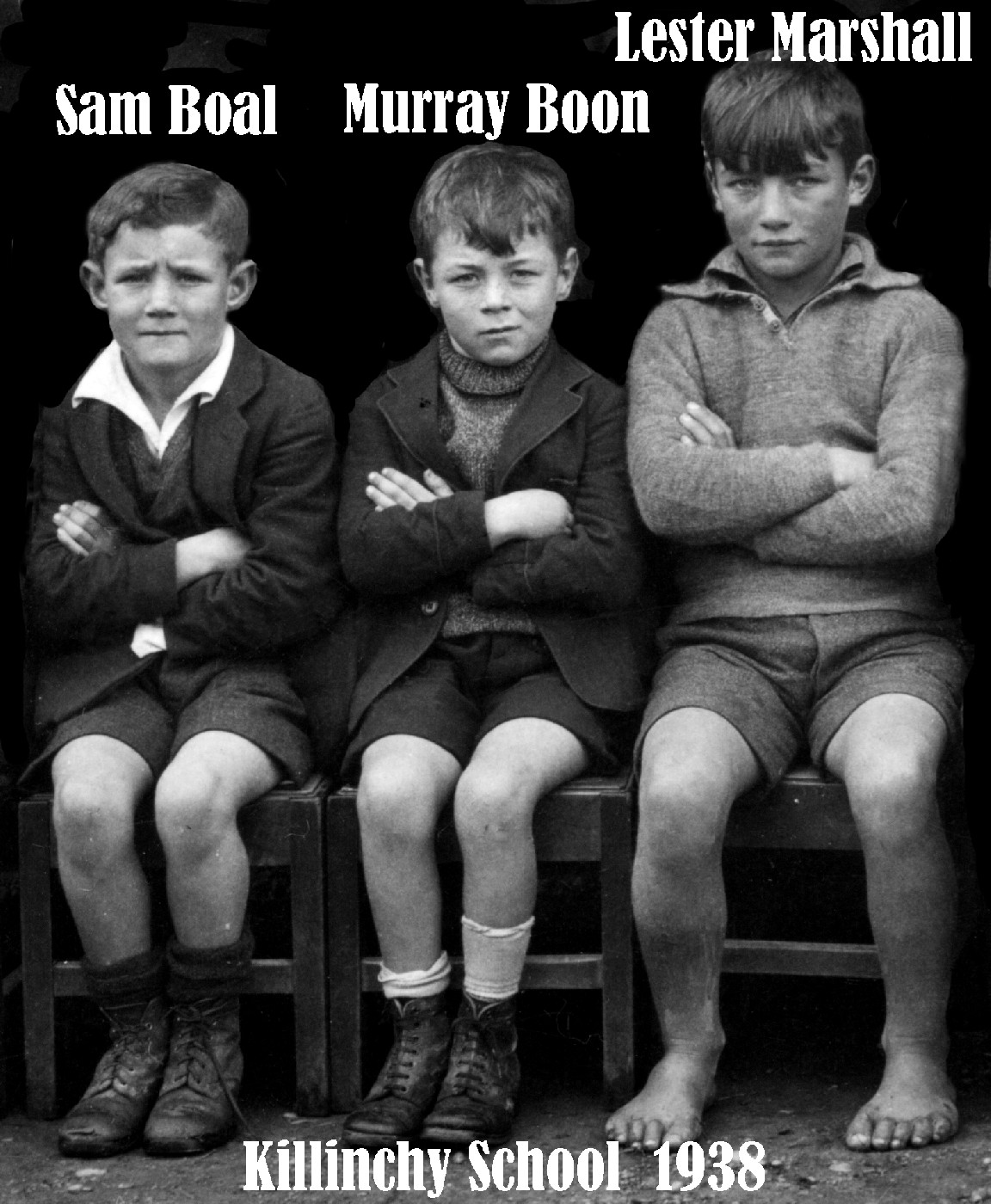 Murray Boon at Killinchy School5 August 2021
 Nancy Lowery (nee Riches) at Killinchy School19 August 2021
 Peter Lemon at Killinchy School2 & 16 September 2021
Early days at the Killinchy School pool2 September 2021
 John Irvine remembers the Killinchy School pool16 September 2021
 Killinchy School: the first reunion of 1951-5230 September 2021
 Parent-Teacher Association of Killinchy School14 October 2021
 Combined Killinchy School and Tennis Club reunion 199728 October 2021
 Murray Boon describes conversion from Killinchy School to Killinchy Hall11 & 25 November 2021
 The Killinchy Tennis Club relocates to the Killinchy School site16 December 2021
Opening of the first and second Killinchy Schools By Mike Noonan · researched by Mike Noonan & Sandra Opie · The Ellesmere Echo, 2021 Read ▾
Maybe it was one person or a group of people who collected the signatures of the householders wanting to have a public school at Killinchy and presented a “memorial” to the Board of Education.
Just as happened in (Upper) Selwyn, a report appeared in the Press, 22 October 1870, stating that “a considerable portion of the inhabitants of the Killinchy district” wanted to have a public school education and a separate educational district, thus the Board called a public meeting of the “owners and occupiers of land and householders resident in Killinchy” to be held on Monday, the 31st of October, 1870, at 7 o'clock pm, at the school-room, Killinchy.
The meeting was called to be sure that there was sufficient interest in forming a school district and if the Killinchy people would pay part of the expenses.
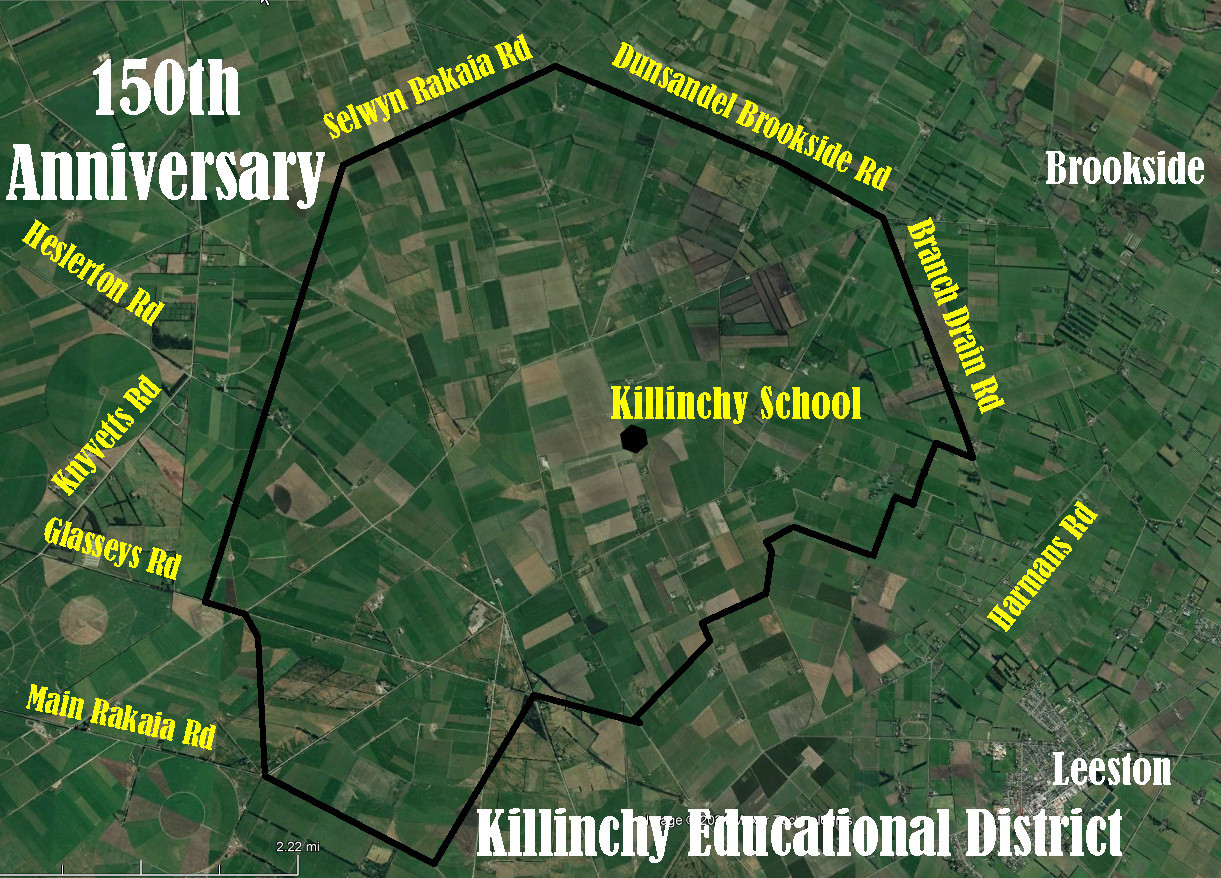
The advertisement also defined the boundaries of the Killinchy Education District which are drawn on a Google Earth map that accompanies this article.
In places, the boundary follows the roads, in others boundaries of Rural Sections, or in 3 areas it goes straight across land that had not been sold which would have been interesting for people who bought land later and had the boundary run across their land.
This advertisement suggests that there was a pre-existing school room (first school).
It is believed that it was “a sod house in the general locality”.
A later report suggests that a school committee may have been in existence for 6 months prior to the public meeting, perhaps organising the “memorial”.
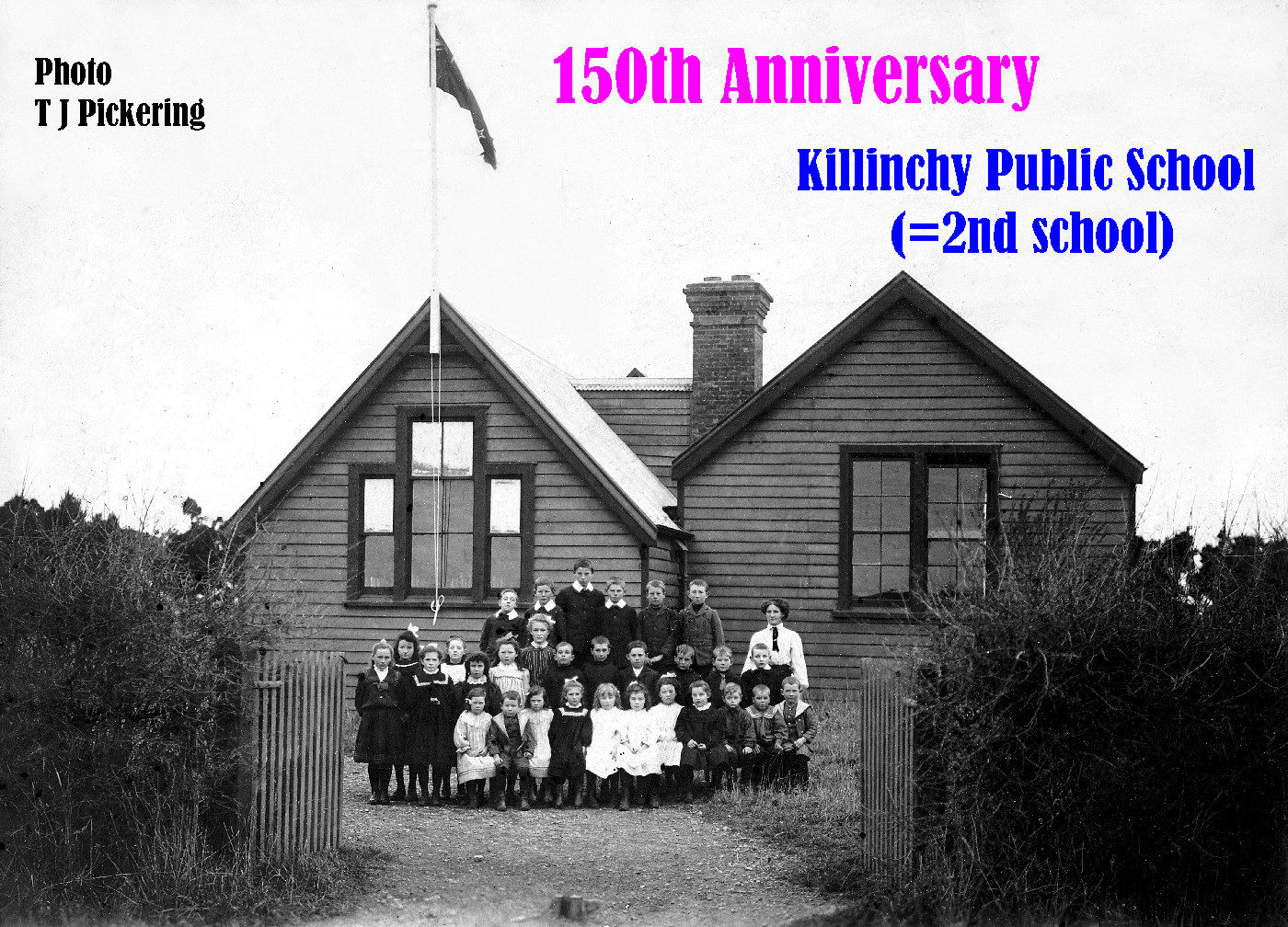
Approximately one month after the public meeting, another advertisement appeared calling for tenders for the building of a school room (second school) and a master’s house.
A District Committee had been set up and the tenders had to be delivered by the 19th of December either to Christchurch or to Amos Sherratt, chairman of the committee, at the Selwyn Station.
With the establishment of the Killinchy Educational District, an alteration needed to be made reducing the size of the Leeston Educational District.
By January of the following year, 1871, an advertisement for a schoolmaster appeared.
A report of the Board of Education for the year ending March 1871 stated that “schools are on the point of coming into operation in the Killinchy and Greenpark districts, near Lake Ellesmere”.
All went well during construction. “The contractors, Messrs Rastrick and Sons, finished the house and schoolroom on March 28th 1871, in a very substantial manner.
The buildings are lined with wood throughout, and reflect great credit on the committee, the contractors, and the district generally”.
The committee, having elected Mr. J. Maddison as schoolmaster, agreed to open the school on Monday, the 3rd of April 1871, by giving a treat to the children of the district likely to attend the school.
Unfortunately, the weather was not at all favourable.
The children began to arrive at one o'clock, and shortly afterward upwards of forty were sitting in the schoolroom, and were regaled with tea, cake, &c, to their hearts' content.
The ground being so wet, they could not have any outside amusements and were therefore soon obliged to go home.
At six o'clock a tea meeting took place, when the room was well-filled.
After tea, the tables having been removed, a number of men addressed the meeting.
The secretary read his report, and with the balance appearing on the right side, everyone was pleased.
The meeting dispersed about 11 p.m., generally satisfied with the entertainment provided.
Mike Noonan & Sandra Opie,
Ellesmere Historical Society
By Mike Noonan · researched by Mike Noonan & Sandra Opie, Ellesmere Historical Society. First published in The Ellesmere Echo, 2021. Reproduced from Selwyn Stories under CC BY-NC 3.0 NZ.
The 5th anniversary of the Killinchy School By Mike Noonan · researched by Mike Noonan & Sandra Opie · The Ellesmere Echo, 13 May 2021 Read ▾
In early March 1876, the 5th anniversary of the school was celebrated after the school year started late because of improvements to the school, the result of a rapid increase in pupil numbers.
The Press reported that “Goodly numbers of residents assembled during the day, notwithstanding the cheerful, hum-hum of the harvest machine. The children assembled in force. Sports for them were set a going in Mr Davison's paddock…... Tea followed, Mr. Paddy, of Southbridge, being the caterer.
The adults next looked after their refreshments, which were by no manner of means the scholars' scraps.
Mr C.A. Fitzroy, chairman of the committee, having a full house before him, addressed the people and children, congratulating them upon the extension of the building….. He said he fervently hoped many good would follow, especially the sanitary one (Killinchy school had hitherto providentially escaped neighbouring epidemics.)
The chairman then presented prizes in accordance with Inspector Hammond's report, and that of committee members’ Christmas examination.
The McKee family was prominent in the prize giving.
Thereafter, cheers were given for the teachers, Mr. and Mrs. Murray followed by Mr. Fitzroy, the sub-committee, and the young lady assistants.
“Dancing was mildly indulged in for a while by a selected few, after which the meeting broke up.”
During the five intervening years, annual householders’ meetings were held in the school room and so many men wanted to be on the school committee that voting had to be conducted.
By the end of 1873, Headmaster Maddison had resigned and the committee advertised for a new master, assistant teacher and sewing mistress.
By February 1874 they were looking to appoint Mr. Murray and his wife to fill the three positions.
Mrs. Murray was appointed assistant mistress but was required to appear for an exam in June which she failed to do. In January 1875 the Inspector supported Mrs. Murray and she was allowed to continue.
The Chairman of the school committee wrote to the Board of Education requesting that the Board insist that she sit the examination, but the Board reserved its decision.
The Murrays taught at Killinchy until September 1877.
Another staff matter that gained newspaper space concerned a sewing teacher. In October 1872 an anonymous letter was sent to the Board of Education objecting to the appointment of a sewing mistress.
This letter was torn up.
A letter on the same subject was also read from Mrs. Atkinson.
The Board decided to defer any action in this matter until the election by the committee came before the Board for confirmation.
One week later readers of the Press which reported on the next Board of Education meeting were informed that “a letter was read from the chairman of the school committee, notifying the appointment of Mrs. Mason as sewing mistress, subject to the approval of the Board” but the Board “postponed the consideration of the appointment of Mrs. Mason until the next meeting”
Readers of the Lyttelton Times were however provided with additional information about the same meeting “Mr. Bowen (a member of the Board) said several persons had spoken to him to the effect that Mrs. Mason had only been elected by the casting vote of the chairman, who was her husband, and had expressed a hope that the Board would not sanction the appointment until after the election of the new committee”.
Mike Noonan & Sandra Opie
Ellesmere Historical Society
By Mike Noonan · researched by Mike Noonan & Sandra Opie, Ellesmere Historical Society. First published in The Ellesmere Echo, 13 May 2021. Reproduced from Selwyn Stories under CC BY-NC 3.0 NZ.
The O'Briens, one of the early families at Killinchy School By Joanne Knudson (nee O'Brien) · The Ellesmere Echo, 27 May 2021 Read ▾
Mathew O’Brien was one of the first inhabitants of Killinchy having bought Rural Section 4837 on the Leeston Dunsandel Road, of 120 acres from Charles Shaw for £276 in 1863. The farm was called “Ennisvale”.
Mathew was born in Mountscot, Knockananlban, County Clare Ireland in August 1841.
He had arrived in Victoria in the 1850s and according to his obituary, it was a “most stirring and eventful as well as successful one.
With the discovery of gold in Otago he sailed for NZ and was also successful there.
He added to his original land a piece of 21 acres and 3 roods in 1865, alongside his original block.
By 1866 he had built a sod house and stockyards on the original 120 acres.
Mathew added another 60 more acres in 1867 also alongside the original block.
In 1877 he leased 250 acres across the road and purchased it fully in 1886.
Mathew married Julia Higgins from County Galway (born 1844) at the Church of the Blessed Sacrament, Christchurch in 1867. Prim
Julia had immigrated to New Zealand at the age of 21 years old with her brother and his wife in 1865 on the ship the ‘Victory’.
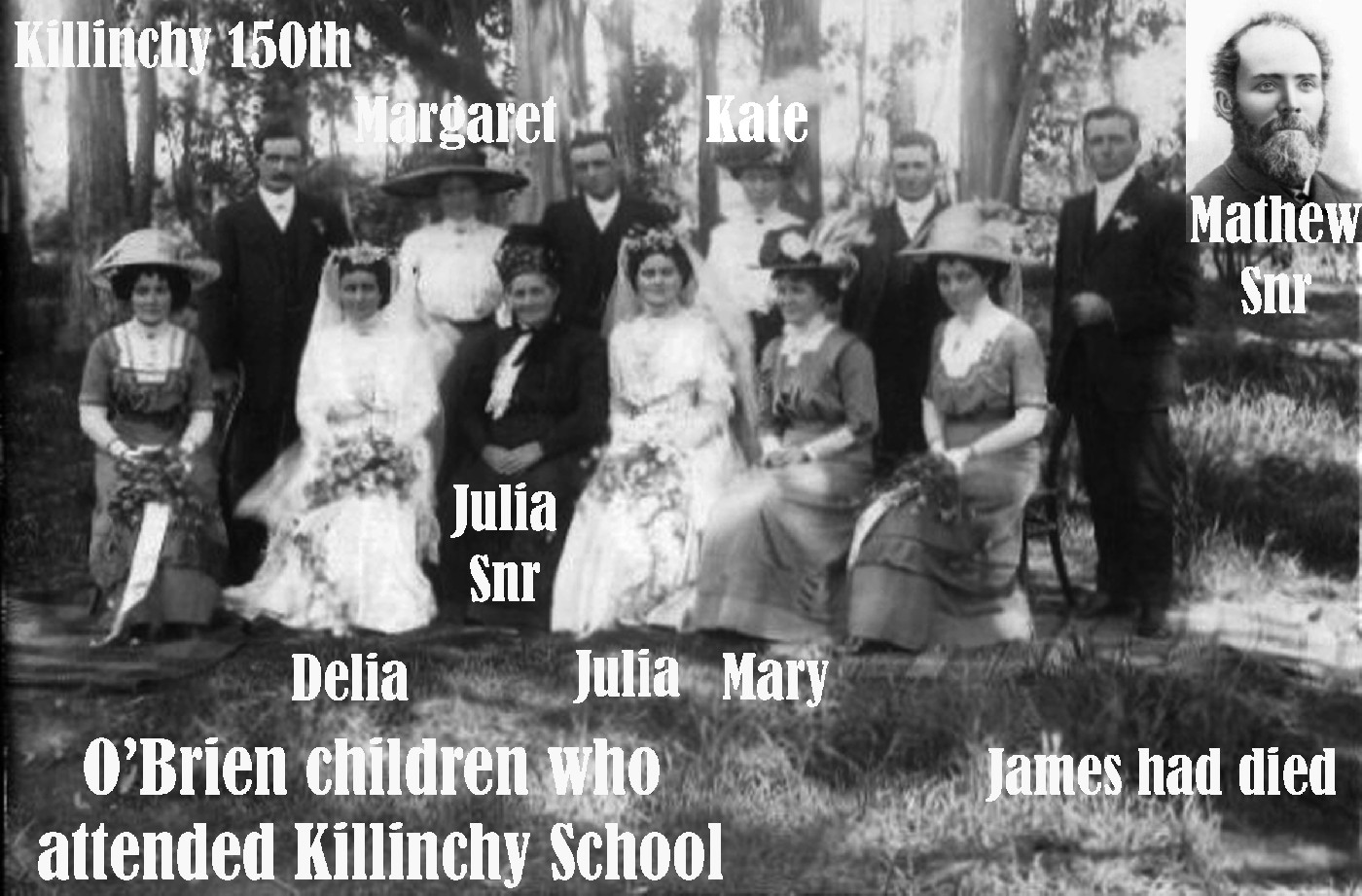
Mathew and Julia had 13 children.
Their first child, James (Dec 1867) started at Killinchy School in 1874 aged 6.
In December 1868, Kate their first daughter was born. She went to Killinchy School from the age of 6 until she was 12.
Mary (1870) attended the school from 1877 -1880.
Julia (1871) was a pupil at the Killinchy School from 1877 to 1880.
Bidelia (Delia) (1873) and then Margaret (1874) both attended Killinchy School in 1879 to 1880.
They were the last of the 13 children to attend the Killinchy School.
These five children were shifted to what was later called St Joseph’s Catholic School which had recently opened in Leeston, in January 1880 and the rest of the siblings followed – Daniel (born 1876), John (1877), Rose (1880), Matthew (1882), Ellen (1884), Charles (1886) and Annie (1888).
Mathew had a long interest in the Killinchy School and was one of the auditors appointed by the school committee in 1873 and was a member of the school committee at least between 1876-80.
As the children lived within 1 mile of the Killinchy School we presume they had walked to school.
In 1876 James came second in Class IV while Kate was also second in Class VI.
Mary attended the Killinchy School's 81st Anniversary in 1952 and as she was the oldest ex-girl pupil she was invited to hoist the original school flag to start the celebrations.
Mathew, followed by his sons, were on many committees in the area such as the Killinchy Football and Cricket Club, Killinchy Library Committee and Killinchy Hall Committee with Mathew being the President for some years.
The O’Brien family continued to run the family farm after Mathew died in 1897, and then Julia in 1929, until they sold the farm in 1962 some 99 years after first buying the property.
Great Granddaughter, Joanne Knudsen(nee O’Brien)
Ellesmere Historical Society
By Joanne Knudson (nee O'Brien), Ellesmere Historical Society. First published in The Ellesmere Echo, 27 May 2021. Reproduced from Selwyn Stories under CC BY-NC 3.0 NZ.
Early treats and prizes at the Killinchy School By Mike Noonan & Sandra Opie · The Ellesmere Echo, 10 June 2021 Read ▾
The Killinchy School treats and prize-giving waxed and waned through the 19th century.
The earliest record of a treat for the children of Killinchy School occurred just after Christmas in 1877 when the teachers and promoters of the Southbridge, Leeston, Killinchy and Irwell schools united and met at the “Māori pa” where “abundant refreshments and amusements” were provided. The Rev. W. Harper used every effort to amuse the children, and “the assistance of active and liberal coadjutors made the amalgamated school treat a decided success”.
The outing was marred when a boy was found to be missing, feared drowned as the children had been swimming in the sea. Fortunately the youngster “had preferred a means of his own choosing for his return home”.
No further reports of amalgamated treats have been found and for the rest of the century, the treats were solo events linked to prize-giving.
In 1882 a treat was held for more than 150 children and adults on the school grounds prior to breaking up for the harvest holidays.
The “usual games and sports” were held before refreshments were served.
After tea “an adjournment” was made to the schoolroom to distribute prizes. Mr Watson, the Master, distributed the prizes, then votes-of-thanks and the gathering dispersed, “all seeming thoroughly satisfied with the day's amusement”.
The treats of 1884 and 1885 followed a similar pattern, again around harvest time.
The committee decided to cancel a treat in 1886, and to put the money into more expensive books.
Milson Jones, Chairman, distributed £10 worth of books. Every child received something, but those who had passed their standard at the last examination received a more expensive book than those who had failed.
Lollies and biscuits were then distributed, and a half-holiday was taken in honour of the occasion.
On New Year's Day, the annual school treat for 1891 was notable for two reasons.
Firstly it was held away from the school grounds, in James Spence’s paddock, and secondly, the hall was used rather than the schoolroom.
Neither trouble nor expense was spared in making the gathering a success.
In spite of counter-attractions and threatening weather, a large number of children and their friends assembled, and a most enjoyable day was spent. Tea was served on a table, seating up to 50 people, at 5 o'clock, and the “company” sat down in relays.
Children’s sports, with “liberal money prizes” were provided and every child left with some memento of the day's proceedings.
One of the most noticeable features was the annual match between the Cricket Clubs of Upper and Lower Killinchy. The game ended in an easy victory for the Lower Killinchy team. A very enjoyable dance ended the day.
From 1892 to 1895 the pattern was similar although held in April.
In 1896 the committee had decided not to have the school treat or distribution of books, but took the children to the Exhibition instead.
The century finished on a wane, as the 1898 committee decided not to have any school treat or distribution of books, as the school prize fund was so low.
Mike Noonan & Sandra Opie
Ellesmere Historical Society
By Mike Noonan & Sandra Opie, Ellesmere Historical Society. First published in The Ellesmere Echo, 10 June 2021. Reproduced from Selwyn Stories under CC BY-NC 3.0 NZ.
Staff, pupils and committee of the Killinchy School By Mike Noonan & Sandra Opie · The Ellesmere Echo, 24 June 2021 Read ▾
Staff
It is understandable that there would be similarities in staffing between the Selwyn and Killinchy Schools as regulations, pupil numbers and social views changed over time.
All head teachers (at times they were sole teachers) were male until the Committees were brave enough to appoint a female at both schools at the turn of the century.
At Killinchy, the 19th century males stayed an average of 3 years with W. Tipler’s 13 years (1889-1901) an exception, while Selwyn’s turnover was much more rapid.
Miss Warnock taught for 23 years (1902-1926) at Killinchy which far exceeded the male efforts and Miss Christian (1902-11) at Selwyn exceeded her male predecessors greatly.
Only 2 more female head teachers were appointed at Killinchy, and this was for a short period and during WW2, while at Selwyn, females led the school through to 1928.
When pupil numbers justified a second teacher, usually a female was appointed, and at times, pupil-teachers were also being trained at schools.
Mary McKee served at Killinchy from 1875 to at least 1879 when it was reported that she had failed her exams and Sarah McKee had her 1st year exam in 1884 and 3rd year in 1887.
Sewing teachers were often the wife of the male teacher and were part time.
Pupils
In the early days, attendance at school was poor by modern standards.
For example, in 1876 of 82 pupils enrolled there was an average attendance of 59, which was apparently in excess of former years.
By 1880 average attendance had increased to 70 pupils, and dropped by 1882 to 64.
In 1891 the Master reported that attendance was 90% of the school roll.
Graham & Chapple reported that peak pupil numbers at Killinchy in 1890 was 160 (compared with Southbridge School in the same year with 389) and these figures suggest that the peak was very sharp.
The Committee Chairman reported in 1898 that the roll number was 44 as against 47 for 1897 and average attendance was far below what might reasonably be expected.
School Committee
The School Committee was voted in at a meeting of the residents held annually at a date specified by the Education Board. The chairman was chosen from among the elected members.
For all the years until the school’s closure in 1959 it was a male preserve.
In the very early days a couple of members of the committee, assisted by the teacher, would conduct the examination prior to awarding prizes.
The committee’s main tasks were to see what needed to be done around the school and then to petition the Board of Education for the money to carry out the work.
The committee had to raise one-sixth of the money if the request was successful, then advertise and select the tender, confirm their choice with the Board and presumably supervise the work.
Things didn’t always go smoothly for the committee as for example in December 1888 when a small sub-group of the committee contacted the Board of Education over the effectiveness of a teacher without consulting the rest of the committee. This led to a heated special meeting and unpleasantness.
A new teacher started in 1889.
Mike Noonan and Sandra Opie
Ellesmere Historical Society
By Mike Noonan & Sandra Opie, Ellesmere Historical Society. First published in The Ellesmere Echo, 24 June 2021. Reproduced from Selwyn Stories under CC BY-NC 3.0 NZ.
Killinchy School during the reign of Selina Warnock 1902-26 By Mike Noonan & Sandra Opie · The Ellesmere Echo, 8 July 2021 Read ▾
Selina Warnock was head teacher from 1902 to 1926 and as such saw the retirement of the second building and the construction of the third and final school building. This is the building that is the Community Centre today.
She was sole teacher for seven of her teaching years leading up to WW1. After that there were two teachers until her retirement.
By 1904, with Selina in charge, rather than picnics in the school grounds it was off to Governor’s Bay on the train and the steam launch, “Canterbury”.
The next one reported in the paper was to Wainoni Park in 1913. With the war raging in 1914, the pupils decided to forgo their treat and donate money to the poor people affected by the fighting.
In 1915 and later years, the picnic was at Lake Ellesmere and the party was taken boating on the lake in Major Overton’s and R.M. Taiaroa’s fine motor launches.
Selina suffered a serious illness in 1906 but recovered to resume her teaching.
She donated books to start a school library and in 1913 a packed concert supported the addition of books.
During WW1 the children kept up their fundraising efforts for Lady Liverpool and Red Cross funds with a concert at the school, repeated at the Lakeside Hall.
The following year a concert was held in aid of the Soldiers’ Christmas Parcels and a dance followed.
A large gathering of parents and children gathered at the school on 3rd May 1921 to witness the unveiling of the school Roll of Honour which held nearly 70 names of ex-pupils who had served.
On the 14 November 1924 The Press announced that the Education Department had made a grant for the rebuilding of the school and in mid-December tenders were called.
This advertisement was followed one year later by calls for the purchase for removal of the old school building which began a new career.
In June 1926, the Ellesmere Guardian announced that Miss Warnock, who had been in charge of Killinchy school for about 24 years, was about to retire and that steps were being taken by the residents to show their appreciation of her splendid work.
In early July every household in the Killinchy district was well represented at a farewell social for Selina and her mother.
Songs, recitations and other items were greatly enjoyed.
John Cunningham, the then Chairman of the Ellesmere County Council, considered it an honour to say that Miss Warnock has been such a good Ellesmere citizen and had occupied a most important position in the Killinchy district for a lengthy period.
Of giving up teaching Selina said that “I have been here for 24 years and this is the hardest thing I have to do”.
“For they are jolly good fellows” was sung very heartily, and supper was served at the close of the social.
Mike Noonan & Sandra Opie
Ellesmere Historical Society
By Mike Noonan & Sandra Opie, Ellesmere Historical Society. First published in The Ellesmere Echo, 8 July 2021. Reproduced from Selwyn Stories under CC BY-NC 3.0 NZ.
Stan Pycroft at Killinchy School By Stan Pycroft · The Ellesmere Echo, 22 July 2021 Read ▾
My education was a bit hairy because I couldn’t get into school properly.
My father was a blacksmith who lived at Burwood and I used to go to my grandparents quite regularly.
My grandfather had a brother, Frank and his daughter was a schoolteacher at Phillipstown School.
This particular day she came to me and said "Young man you’re not at school yet".
And my grandmother said "No" and she said, "You are going to school tomorrow".
She took me to Phillipstown School and I was there for six days because it was the start of the Christmas holidays at the school. So that was alright but while I was in there; my father had shifted from Burwood to Killinchy and my auntie Ella she came round and she said you keep an eye on all this paperwork for Stan here for the next year’s school.
I should have been at school when I turned five but I didn't get there until the next year when I actually started Killinchy Primers.
We had a Miss Innes here and I did not like her very much.
I was only there a fortnight and she caught some boys swearing and apparently, she washed their mouths out with soap and water and this did not go down too well with one of the mothers who was at the school sorting things out a bit.
I don’t think that ever happened again.
I graduated into Standard One and Standard Two while I was here and the Standard Two children used to come into this room here and Mr. Bruce he was the headmaster here and he was apparently a bit strap happy and the children, as far as I know, were not looking forward to it.
My father then shifted from Killinchy to Leeston so I finished up at Leeston for two years in Standards Three and Four and then went to Little Rakaia School.
Then my father shifted back to Killinchy and then this particular day he went up to Mr. Alec Allen's place and he found out that I could milk cows and wanted to know if I could milk cows for the school holidays.
"Oh yes", Dad said "that would be alright", so anyway I stopped there for the month and then he wanted to know; so he said to my father, "Why can’t Stan stop here, milk the cows here and go to Killinchy School from here".
My father agreed and I did that for 12 months and by the time I got back the second time; a Mr. Chas Miller was a teacher here at the school; he was the sole teacher and anyway, I got on quite well with him and I passed my education here and my father said "Right you boys when you leave school you can get out and do some work", so that was the end of me so I ended up stopping and staying at Alec Allen’s milking cows.
But the year that I came here I milked the cows in the morning and then milked them at night and then continued my education until Standard Six.
Adapted from a talk given by Stan Pycroft.
By Stan Pycroft, Ellesmere Historical Society. First published in The Ellesmere Echo, 22 July 2021. Reproduced from Selwyn Stories under CC BY-NC 3.0 NZ.
Murray Boon at Killinchy School By Murray Boon · The Ellesmere Echo, 5 August 2021 Read ▾
I haven’t got a great school story but because I was at Killinchy from 1937 to 1946, I’ve got one or two. They talk about Chas. Millar – he was the main teacher when I went to Killlinchy school.
He was a great sportsman; he loved his rugby and of course, we all loved rugby too and spent most of the afternoon playing rugby, which didn’t do our school work much good, but never mind.
I remember one day we were playing in the grounds and he came out after his lunch and joined us.
There wasn’t many of us and he took up the ball and took off out in the field.
He always wore his jacket and tie; was always a neat and tidy man.
Somebody grabbed him by the jacket pocket and tore the pocket right out of his jacket but he didn’t stop and went right down and scored the try and he never said a word about it; just smiled and carried on.
That’s the sort of chap he was and we could all get on very well with him.
After he left we had some indifferent teachers, I might say that - most of them were female.
Some we really played up with and when you look back it wasn’t fair really.
One particular prank we used to play each year; I think it was at the end of the year; we would get the teacher’s strap and cut about an inch off the end and when the old toilets were down the end; it was tacked up above the door there and we had quite a wee row of squares of strap on top along the top of the door; but that was just bye the bye.
Our sporting programme was a bit limited with the numbers we had.
When I started school we had about 50 and it gradually whittled down to about a handful – seven I think when it closed.
The girls and the boys had to make do with one another’s company playing tennis and basketball, as it was then.
Of course when we had other teams come; like the other schools used to come and play; my father had the paddock over the road and we had a proper field and that was joy; we could have goal posts and all.
When we went to school there were seven in my family.
We used to have to run home at dinner time as there were too many for Mum to make lunch for.
Then there was a hell of a race to get back to play rugby.
That was my Killinchy school days.
Adapted from a talk given by Murray Boon
Ellesmere Historical Society
By Murray Boon, Ellesmere Historical Society. First published in The Ellesmere Echo, 5 August 2021. Reproduced from Selwyn Stories under CC BY-NC 3.0 NZ.
Nancy Lowery (nee Riches) at Killinchy School By Nancy Lowery (nee Riches) · The Ellesmere Echo, 19 August 2021 Read ▾
My sister Olive (who was 2 years older than me) and I started at Killinchy on the 4 April 1934.
We had two miles to walk to school on a shingle road but there was an arrangement then that the mailman would bring young children to school in his mail car so school didn’t start until half past nine and finished at half past three and Olive and I had a ride in the mail car until she was too old to come on that and she got a bike.
We had two rooms at the school; there was a Mr Bruce and Miss Harper in the junior room.
Killinchy became a sole teacher school in 1937 when Mr Millar started.
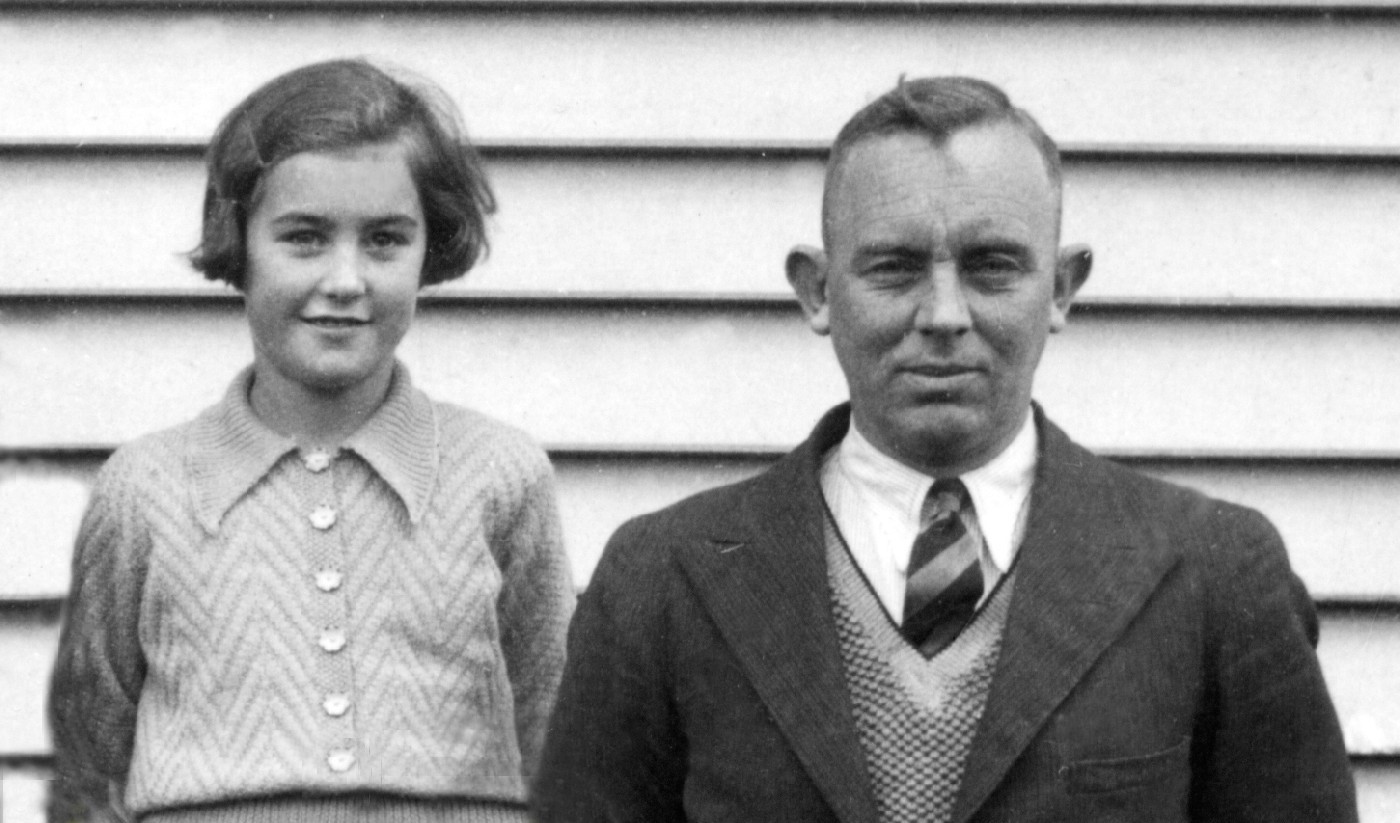
By 1938, when the picture of Mr Millar and I was taken, I was in Standard 3 (Stan Pycroft was in Standard 6) and there were 18 boys and 13 girls at Killinchy School.
We were taught in the one big room.
In my last year (1941), I was the only one in Standard 6. Mr Millar would set school work for me to do and when I had finished I would help the infants with their work. I enjoyed doing that.
Most of the children lived on farms and came to school on their bikes, ponies or walked. I don’t remember anyone coming to school in a car.
Mr Millar was a very good piano player and we did a lot of singing which we all enjoyed.
He would write the words for the new songs on one of the blackboards. No photocopiers in those days.
At the end of the year we had a school concert which was always lots of fun.
The boys and the girls played lots of games together. The boys played basketball (now netball) with the girls and the girls played rugby with the boys.
I liked rugby better than basketball which I thought was a boring game because you couldn’t move all around the court.
We played sports with other local schools that hadn’t been consolidated then.
In the summer time, for swimming, we walked about a mile to the culvert at Bray’s corner and learnt to swim in the Doyleston Drain.
When we could swim the length of the culvert, which was the width of the road, we were taken to the Doyleston Pool.
In March 1941 I got my 250 yards certificate.
In Standards 5 & 6, the Dunsandel school bus took the Dunsandel, Brookside and Killinchy children to Southbridge to the Manual Training centre for woodwork and cooking lessons so I got to know children from those schools.
We did have the pet show. In my last year I got Champion Lamb and for the prize got some pink silk pyjamas.
At the end of the year, we had the school picnic usually going to Coe’s Ford which was a really good picnic place.
One year we caught the train in the morning at Dunsandel and went to Caroline Bay in Timaru for the day, coming back on the late afternoon train.
Adapted from an article and talk by Nancy Riches
Ellesmere Historical Society
By Nancy Lowery (nee Riches), Ellesmere Historical Society. First published in The Ellesmere Echo, 19 August 2021. Reproduced from Selwyn Stories under CC BY-NC 3.0 NZ.
Peter Lemon at Killinchy School By Peter Lemon · The Ellesmere Echo, 2 & 16 September 2021 Read ▾
I remember my first day at school very clearly and felt very much at home there.
It was approximately two miles from home to school and I walked with my older sisters. On the way home I ran ahead of my sisters and played by the ditch until they had caught up.
I watched and chased bullies and scratched around on the bank with a stick and to my delight uncovered a penny.
That penny, which I still have to this day, was enough to buy an ice-cream from ’Akie’, who was Gordon Atkinson, who sold ice-creams. He came to the school once a week while doing his Killinchy fruit and vegetable round.
I was pretty happy to get that ice-cream and never forgot it.
During my first week at school here some of the local farmers - they would probably have been fathers of the school children - brought a tractor here and started up the saw bench and cut up the firewood.
There were a lot of pine trees round here and they were being cut up, so I did exactly what I would do at home when the saw bench started.
I just hopped out of my seat and went out to watch them. My two sisters were pretty horrified and told me that you just can’t do that - when you go to school you just have to sit in your seat.
But the teacher didn’t seem to mind and I watched the men cutting firewood and I was happy.
As I said, when I first started school, I either walked or we had a bike.
But when my younger brother and sister started school, Mum got us a ride on the mail cart. He used to come before school and he would go right around Killinchy. We used to sit in the back and it would have these great big trays with all this fresh bread; great big loaves that broke in half and when you broke them, one half would have a little hollow in the end and we thought we could pick the lump off the other half and no-one would know. All that fresh bread was just beautiful but anyway we got caught and were kicked off and we finished up walking.
I remember when we had the school milk. All that lovely warm milk! We also used to make cocoa and had a lot of hot cocoa in the winter.
After the open fireplace we had a ‘pot belly’ stove and we heated it on the stove.
We also used to dry the football out. We were not supposed to take the football out when it was wet, but we did. We had a brand new football and we got it wet and thought ‘we’ll fix this’ and we quietly put it in front of the fire and it dried out beautifully before lunchtime. We took it out and the first boot that went into it, went right through it. It had become so hard, so that was the end of that.
I remember telling Dad that we didn’t have a football and he told me that you could make a football out of a pig’s bladder, so in due course they killed a pig and I said I wanted this pig’s bladder. He brought it home and chucked it at me and it was this horrible wet thing, but anyway, I managed to get it blown up and dried off and we used it for a couple of hours and then it broke.
The boys’ toilets were at the corner of the playground, beside the pine trees and if you wanted to go to the toilet, you had to put your hand up in front of all the other children and leave the room and run right across in the long grass to the toilet - it seemed quite a long way.
One boy was too nervous about putting his hand up to ask to go to the toilet. He just quietly sat there and wet his pants.
During the nesting season the magpies would come down and swoop over you from their nest in the pines - that was probably another thing that he wasn’t very happy about.
We played rugby in Mcllraith’s paddock across the road and I remember being told off for being late back. We said we did not hear the bell but that did not wash with the headmaster at all.
Many remember Mr Blackmore - he was a lovely man and was the school’s agricultural man. I think he also had something to do with the school gardens. I have fond memories of him.
In 1945, when the war ended the teacher came back from lunch and she’d been listening to the radio and said “I want you all to go into the other room” - that was the one at the back where the piano was – “we’re going to play “God Save the King”.
Well, we all got in there and I can remember it as clear as a bell; she stood there and she had us all around in a circle and she brushed her skirt down and sat down on the chair. Well she went straight back up off the chair because there was a pin in the seagrass.
We had a girl there who was supposed to sweep the school out - she was paid to do so.
Instead of sweeping the school she used to sit and play the piano and just swished the broom about a bit thinking she had satisfied everyone and then go home.
Well, we didn’t think that was fair and some of the older ones got a piece of cardboard and they pushed a pin through it and folded the cardboard underneath and put it in the seagrass. And would you believe - it was declared the end of the war and the teacher came in and instead of this girl sitting on it, she sat on it!
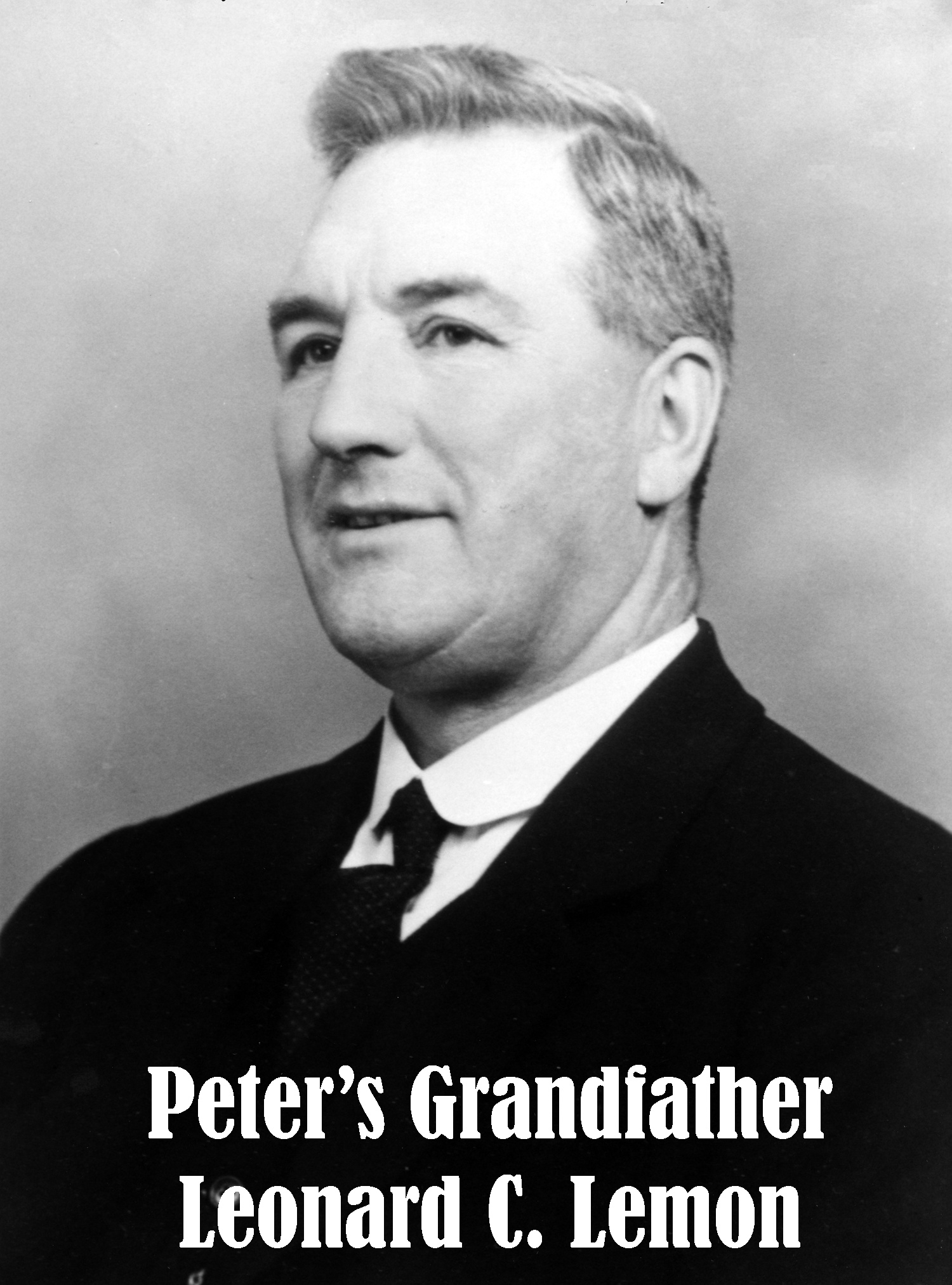
My grandfather apparently burned the toilets down.
He had a pet dog and he walked to school with the dog, playing in the ditch on the way and the dog got stuck in the culvert. By the time he got the dog out and arrived at school he was late, so he got a telling off and was sent outside.
He wasn’t very happy about that so he set alight to the toilet. That was my grandfather!
My father and his brother and sisters, who were Killinchy pupils, decided to play the wag one day and they hid up the pear tree at home; they did not go to school. They had a cut lunch with them of course and they sat up the pear tree.
Well old Granny Lemon saw them up the tree and she twigged what was going on so she got her knitting and a chair and went out and sat under the tree.
She knitted away quite happily there until 3 o’clock and then she picked up her chair and away inside - nothing was said.
Adapted from a talk by Peter Lemon
Ellesmere Historical Society
By Peter Lemon, Ellesmere Historical Society. First published in The Ellesmere Echo, 2 & 16 September 2021. Reproduced from Selwyn Stories under CC BY-NC 3.0 NZ.
Early days at the Killinchy School pool By Mike Noonan · researched by Mike Noonan & Sandra Opie · The Ellesmere Echo, 2 September 2021 Read ▾
The first record of a desire to build a school pool at the Killinchy School occurred at the 1930 school committee AGM where it was resolved to send a letter to the Canterbury Education Board to enquire about “particulars with regard to construction of a school bath, specifications and probable cost.
Also if the Board would subsidise any funds raised towards same”.
The Board replied offering to supply plans and subsidise any money raised locally up to £200.
The chairman offered £20 if four others would come forward with a like amount and the committee were asked to find out how much support there was among the householders.
Sometime prior to a letter written to the secretary of the Education Board by T.E.G. Allen, secretary of the school committee in October 1949, an application for a learn-to-swim bath had been made and the residents of Killinchy had raised £317 at a bazaar.
The residents were prepared to supply labour if that was not a sufficient sum to pay for the new pool.
A letter from the Education Board followed in November of the same year saying that the building controller had now approved the release of cement to enable learn-to-swim pools to be installed at schools and asked the Killinchy committee to provide further information.
Priority was to be given to those schools where committees had the necessary funds on hand and where there were no engineering difficulties.
The Education Board had decided to standardise the size of pools and while the district wished to have a 45’ x 15’ pool, the school committee suggested they would be happy with a 40’ x 15’ pool.
The school committee suggested that the pool could be emptied into the county water race.
In March 1950 the Board advertised in the Christchurch newspapers for tenders for the construction of pools at Halswell, Dunsandel, Killinchy and New Brighton South. Clifford D. Dalzell from Market Street, Leeston tended £746 contract price for the Killinchy pool and affirmed that the pool could be completed by February 1951.
In December 1950 the tender was reduced to £640. The assistant secretary of the Education Board applied to the Director of Education for a £300 subsidy on a 40’ x 15’ learn-to-swim pool and noted that the school committee had the balance of £340 in hand.
Dalzell applied for a progress payment of £300 which was approved in February 1951.
The architect applied for a building permit to the
District Building Controller in mid-February 1951 pointing out that there were 26 pupils on the roll and the nearest bath was situated at Leeston, 4 miles away also that it was not desirable for Killinchy children to receive swimming instruction at Leeston for many reasons.
The school committee sent their £340 cheque to the Board towards the end of February 1951.
The consent for building was approved on 22 March 1951 with the specification that galvanised piping was not to be used for hand rails.
As evident in the photo, the pool opened without a fence, so in early October 1951, the Killinchy committee decided that it was time to erect a fence and dressing shed, and wrote to the Board asking if plans needed to be approved and if there was any subsidy available.
They were told that the architect needed to approve the design and materials and informed them that there was no further subsidy. And so the pool began its many years delighting swimmers.
Mike Noonan & Sandra Opie
By Mike Noonan · researched by Mike Noonan & Sandra Opie, Ellesmere Historical Society. First published in The Ellesmere Echo, 2 September 2021. Reproduced from Selwyn Stories under CC BY-NC 3.0 NZ.
John Irvine remembers the Killinchy School pool By John Irvine · The Ellesmere Echo, 16 September 2021 Read ▾
"I can remember my first swim in the Killinchy pool. It was in the foot bath because I was then too small to be able to hack the pace in the ‘big’ pool.
The water in the foot bath used to get quite warm from the sun heating up the shallow depth.
Once I was big enough I was able to take on the big pool which was still over my head but once I got my confidence up there was no looking back.
There were many enjoyable hours spent cooling off in the water & sun bathing on the concrete surrounding the pool or if the concrete was too hot we would sunbathe on a wooden bench seat which was situated on some grass at the deep of the pool.
It was always a bit of a lottery as to how the water temperature was because if it was freshly filled with that good Killinchy ground water it would be freezing for a few days before the coolness had dissipated from the water.
Or sometimes you might turn up for a swim & find the water a bit green with algae build-up but we didn’t care & jumped into the water regardless.
Often I would find myself sharing the water with floating dead bees, pine needles from the nearby pine trees, thistle & dandelion flowers & miscellaneous debris deposited by the Canterbury winds.
I remember the McDrury girls who lived in the school house next to the pool used to swim so much in the pool that their hair turned a bluey green like the colour of bailing twine.
At that time I don’t think many chemicals were used in the water so maybe it was the algae build-up that caused their hair to change colour.
I remember attending various working bees where the locals would turn up to help prepare & repaint the interior of the pool.
In the spring before the use of chemicals to control the algae build-up, it was always an all hands on deck working bee to drain the bottle green water from the pool followed by a big scrubbing session to remove the green tide marks & algae stains from the blue walls and bottom of the pool interior.
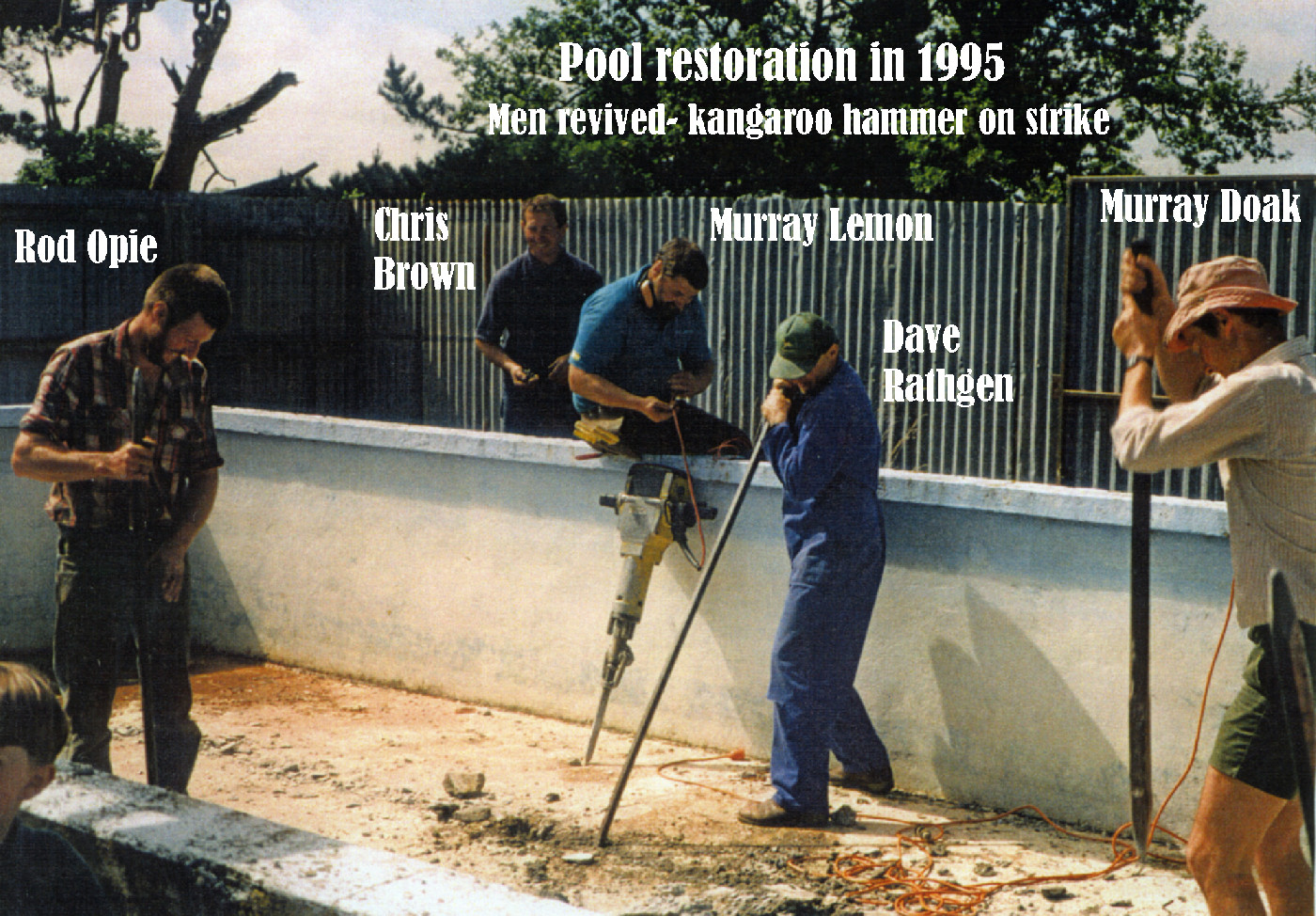
A major upgrade was undertaken in 1995.
It used to be great fun to hold on to the one of the pipe railings running along each side of the pool as an anchor then thrust your body back and forth to create the biggest waves possible which when big enough would breach the pool interior walls & splash over the sides straight onto the backs of dozing sun bathers laying on the concrete which gave them a panicked rude awakening.
For the people who were observers on the outside of the pool, they always had to watch where they were positioned because of the limited area between the pool walls & the boundary fence, it was pretty easy to get splashed by the swimmers especially if someone did a running honey pot, launched from the top of the pool walls.
I haven’t been to the pool or swum in it for many years but I am sure the Killinchy kids of today still get plenty of use and enjoyment from it like I did and no doubt the honey pots and aqua shenanigans still go on like they always did, all in the name of harmless good clean fun."
Ellesmere Historical Society
By John Irvine, Ellesmere Historical Society. First published in The Ellesmere Echo, 16 September 2021. Reproduced from Selwyn Stories under CC BY-NC 3.0 NZ.
Killinchy School: the first reunion of 1951-52 By Mike Noonan · researched by Mike Noonan & Sandra Opie · The Ellesmere Echo, 30 September 2021 Read ▾
The Preparations
There was a small attendance at the first meeting called in May 1951 to plan the celebration of the 80th anniversary (1871-1951).
At the well-attended second meeting, four days later, it was decided to hold the church service, roll call, banquet, school sports, and ball in November 1951.
At further meetings committees were formed to look after refreshments, transport, decoration, ball, etc. and it was decided to move the date to 4 January 1952.
Last minute arrangements for moving tables and chairs and organising the people into decades were made on the final formal meeting held on December 27th.
Prominent among the committees were the surnames Allen, Boal, Boon, Bray, Chappell, Dawson, Happer, Hill, Irvine, Lemon, McClure, McIlraith, McLenaghen, Mahan, Manson, Rathgen, Riches, Watson, Weavers, West and others.
The Ball
The Killinchy Hall, beautifully decorated with hanging bowls, greenery and streamers of blue and gold, the school’s colours, was able to accommodate the 380 attendees. "Such was the gaiety at the jubilee ball that dancing continued well into Friday morning.” Daybourne’s orchestra played the music.
The Day
While Thursday was wet, Friday 4th “dawned with cloudless perfection.” Around 400 people from as far away as Dargaville and Invercargill attended “one of the greatest days in the history of the Killinchy District.”
Officially the programme began with the hoisting of the original school flag by Mary O’Brien who started school in 1871 and was featured in an earlier Ellesmere Echo article.
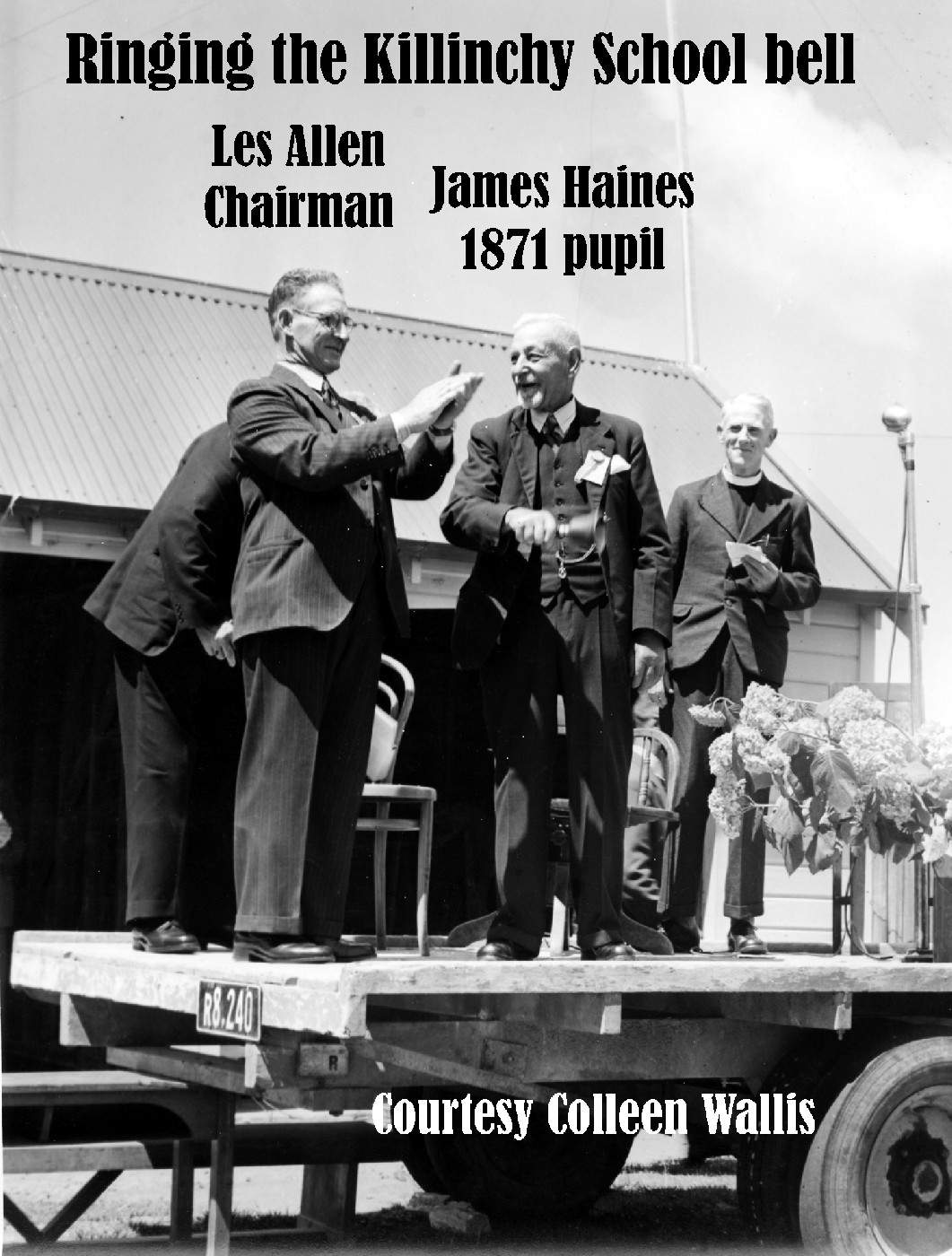
A welcome was extended by Les Allen and then the school bell was rung by James E. Haines who also attended the school in 1871.
There followed a service conducted by the Revs. H.G. Sell and A.M. Costain and then the names on the school Roll of Honour were read by senior pupil Peter Mahan.
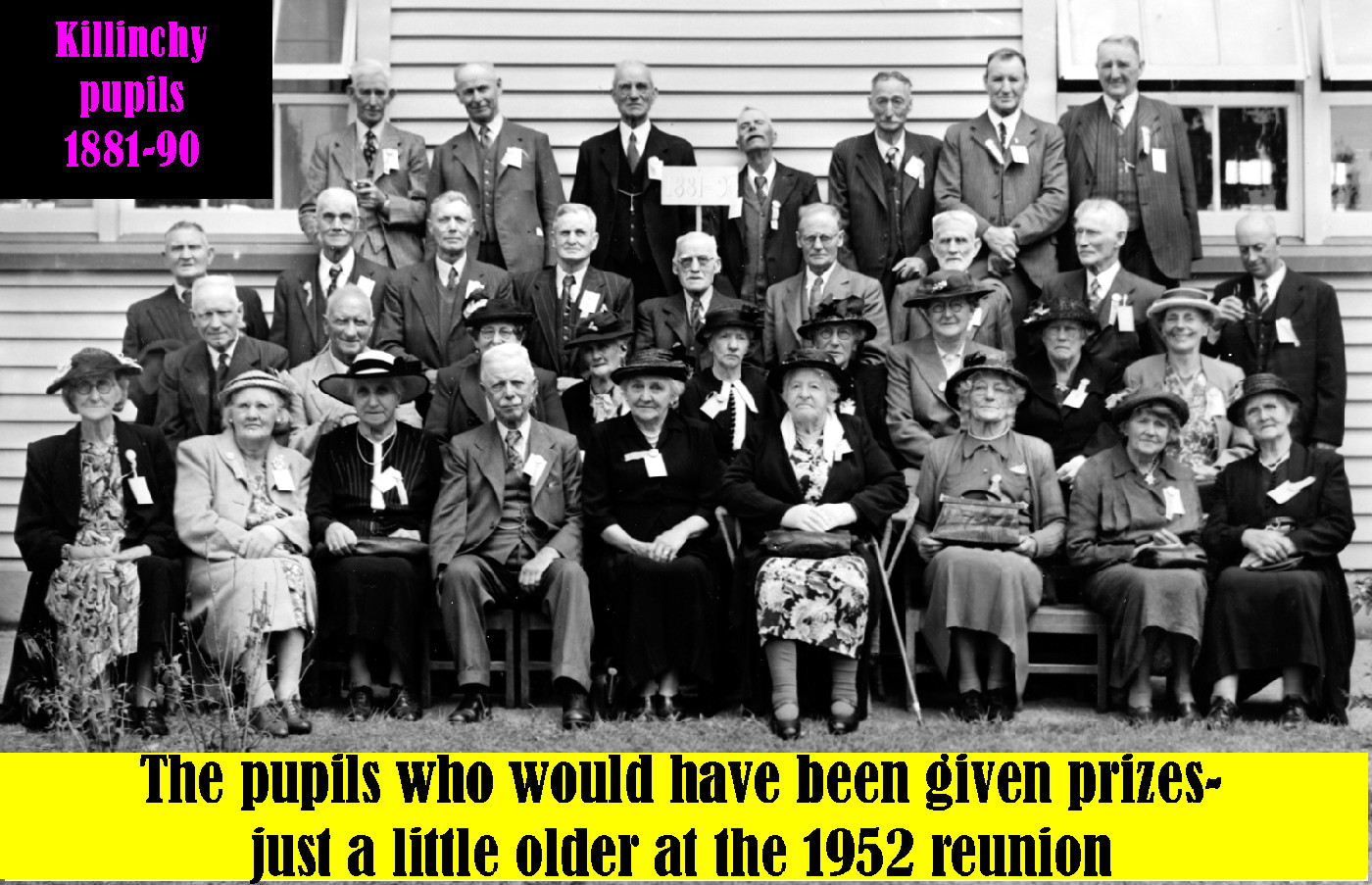
Ex-pupils were then photographed by decades.
The Banquet
A large marquee housed the banqueters at a function which was both well-arranged and carried out.
Numerous speeches covered absent friends, the school, school committees, Education Board, teachers and the chairman.
Much admired at the banquet was the jubilee cake cooked by Mrs. Weavers, the district’s renowned baker and married to Selby, and iced by Miss Jean Lemon.
A model, in icing, of the second Killinchy School adorned the top of the cake.
While the banquet was in progress the children were entertained by a ventriloquist and a display of conjuring among other entertainments.
A whole £2 ($4) was spent on ice cream for the children.
The Exhibits
A display of old photographs was set up in the school and one of the star exhibits on display was the arithmetic textbook used by early pupil, James E. Haines.
Amongst the usual exercises on compound division, multiplication and simple interest was an unusual section devoted to tare and tret. According to Google, tret is an allowance of 4 pounds for every 104 pounds of suttle weight formerly added to various commodities (as spices) to offset deterioration in transit or chaff removed in cleaning. Now you know.
Mike Noonan & Sandra Opie
Ellesmere Historical Society
By Mike Noonan · researched by Mike Noonan & Sandra Opie, Ellesmere Historical Society. First published in The Ellesmere Echo, 30 September 2021. Reproduced from Selwyn Stories under CC BY-NC 3.0 NZ.
Parent-Teacher Association of Killinchy School By Mike Noonan · researched by Mike Noonan & Sandra Opie · The Ellesmere Echo, 14 October 2021 Read ▾
The Killinchy Parent-Teacher Association KPTA) was formed at a meeting on 6th June 1944.
Within that year the group had started making money with card evenings, formed a study circle to educate themselves about children, arranged fancy dress and dancing lessons and a dance and taken over raising funds, including a raffle, for the school picnic and annual breakup.
Fancy dress school dances carried on for many years.
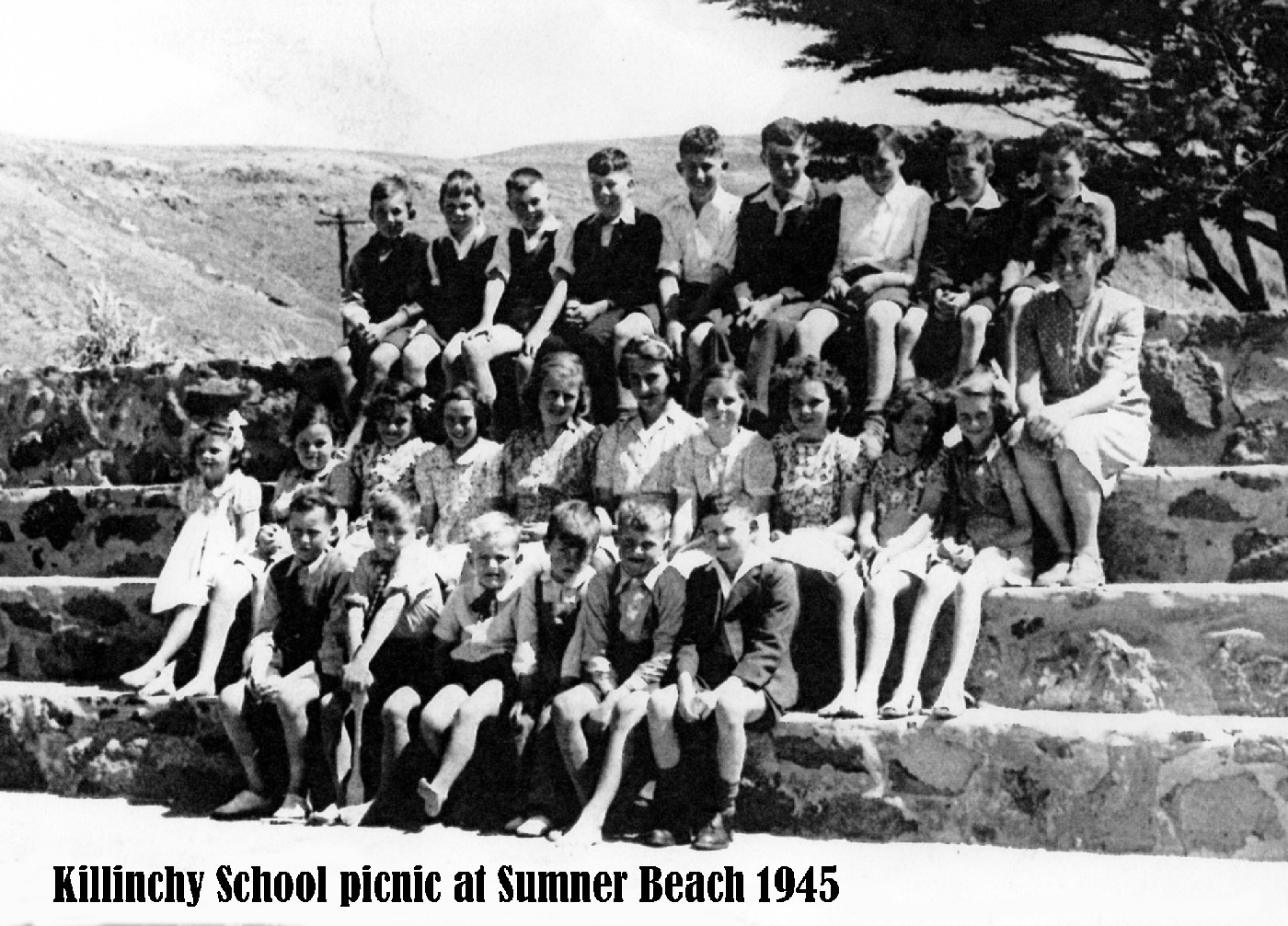
The 1944 and 1945 school picnics were held at Sumner and in 1946 it was up to the parents to choose between Ashburton Domain, Coe’s Ford or New Brighton.
It was also decided in 1946 to take the children to the Christchurch Industries Fair in August.
There was a good attendance at the July 1947 AGM at which it was decided to try and make the monthly meetings more attractive.
At the August meeting a film projector was demonstrated and purchased soon after with money from the KPTA.
As mentioned in a previous Echo article, by March 1949, fundraising for the school pool was the main concern and it was decided to hold a bazaar and take up a collection from residents.
All were occupied organising stalls, inviting guests, writing letters of thanks for donations and organising the collection of equipment.
By June 1951 it was decided to end the card evenings.
In September 1953 it was reported to a KPTA meeting that the school children had planted an English beech tree to commemorate the crowing of Queen Elizabeth II.
Later they went to Dunsandel to see the Queen as she passed through on her way south.
Picnics continued until the school closed and a wide range of places were visited including Christchurch Gardens, Ashburton Domain, Timaru (with Leeston School to hold a sand castle building competition), Karaki Beach, Quail Island, Corsair Bay and Pines Beach.
The pupils of Killinchy School also visited the glass factory in Hornby and carpet factory at Riccarton, the telephone exchange, Lane Walker Rudkin’s factory, Industries Fair, Apex Ice cream factory, antiquarian and winter show, Ernest Adams, Edmonds baking powder factory, Radley’s Woollen Mill among other places of interest, over the years.
In 1957, a little closer to home, a visit to the Council Chambers at Leeston, the Leeston Exchange and Ellesmere Guardian Office.
Several successful functions were held in the 1956-7 year.
Two film evenings, three dances and a fancy dress ball which netted a profit of over £32.
By 1958 the school roll stood at 10 children and at the KPTA AGM, time was spent discussing ways to increase the school roll.
The final AGM was held in July 1959 and arrangements were made, in case the school closed at the end of the year, to transfer monies to the fund to maintain the swimming pool.
Boon, McLenaghen, Rathgen, Chappell, Riches, Millar, Dawson, Blair, Hardy, Manson, Boon, Isles, Hill, Carradous, Lemon, Pycroft, White, Thompson, McIlraith, Moorland were the surnames mentioned in the early KPTA minutes and all those doing anything, were female.
Mike Noonan & Sandra Opie
Ellesmere Historical Society
By Mike Noonan · researched by Mike Noonan & Sandra Opie, Ellesmere Historical Society. First published in The Ellesmere Echo, 14 October 2021. Reproduced from Selwyn Stories under CC BY-NC 3.0 NZ.
Combined Killinchy School and Tennis Club reunion 1997 By Mike Noonan · researched by Mike Noonan & Sandra Opie · The Ellesmere Echo, 28 October 2021 Read ▾
Around 200 registrations, some from as far afield as Australia, were received for the combined Killinchy Tennis Club (70th Anniversary) and School celebrations at Labour Weekend, 1997. Two days of official functions and nostalgic gathering, ended a long period of planning for the organising committees.
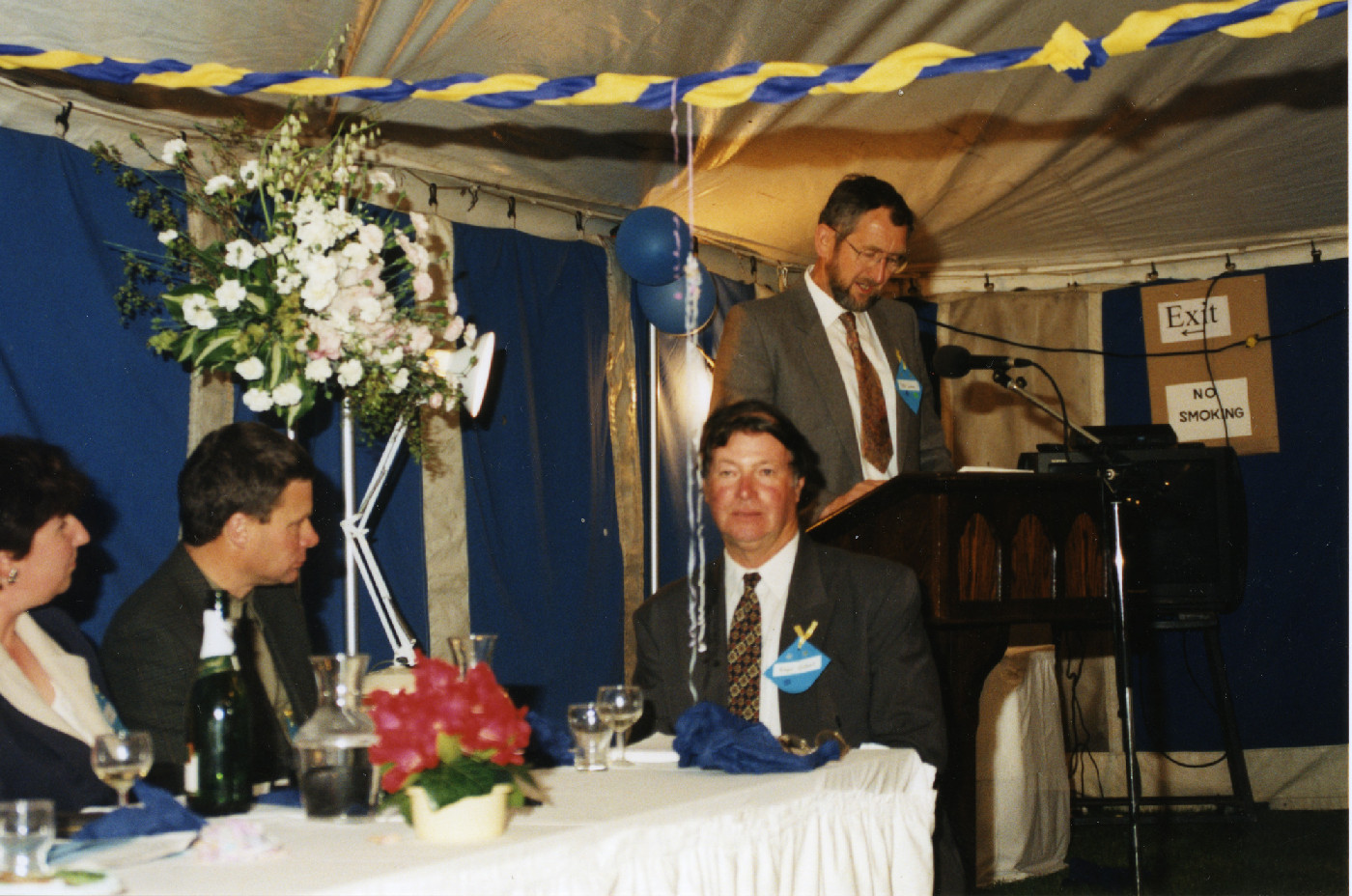
Saturday 25th October 1997 dawned bright and clear for registrations at 11am followed by lunch and various welcoming speeches by dignitaries of the day including Roger Gilbert, Graham Boal, Murray Doak and Wendy Challies representing Killinchy and Ellesmere Tennis; Peter Lemon, convenor Killinchy School committee; and the official opening by Selwyn Mayor, Michael McEvedy.
Peter Lemon welcomed all the former pupils and praised all the former teachers of Killinchy school although none of the former teachers were present at the opening.
Peter noted the advantages of attending primary school in a rural district.
He thanked the tennis club for initiating the celebrations and combining with the school to make a “Killinchy celebration”.
One phone call to an elderly lady in the Ashburton area and after listening to her for over half-an-hour Peter felt he knew her quite well.
She finished up wishing the Killinchy celebrations well but told Peter that she belonged to a completely different family with no Killinchy connections what-so-ever.
Peter concluded his speech wishing everybody happy reminiscences.
The first tennis service on the new courts was undertaken jointly by patron Jim Opie and his nine-year-old grandson, Jared, at the other end of the court.
The new courts were built on the old school grounds so that the Community Centre, swimming pool and tennis courts would form a nucleus for the district.
This was followed by the unveiling of the 70th Anniversary Plaque by Murray Doak and the Spence Family Plaque by Graham Boon, representing the Spence family in recognition of their donation of land to build the original tennis courts on and who had been very prominent in the early days of Killinchy tennis.
Three of the oldest former tennis representatives present, Mesdames Winnie Alexander, Ellen Allen and Lily Garland then cut the tennis jubilee cake.
This was followed by ringing of the school bell by brothers Bert and Ben Legg, oldest former pupils present.
The cutting of the school jubilee cake was then performed.
Decade photographs of both the tennis club and school people were taken at 2.30pm and an hour later afternoon tea was served.
At 6pm there was a Cocktail hour followed by the dinner at 7pm in a marquee beside the hall.
Roger Gilbert presided in the chair.
Shirley James said “Grace” and this was followed by a toast to the “Queen” and one to “Absent Friends”. Roger Boon proposed the toast to the “Tennis Club” and Graham Boal responded. Matthew Allen proposed the toast to the “School” and Peter Lemon responded.
Reminiscences followed.
The celebrations on Sunday commenced with a church service conducted by the Rev. Marian Emslie.
A finger-food shared luncheon followed at 12.30pm. BBQ sausages and drinks were provided.
In the afternoon there were activities and games organized by the Killinchy Country Women’s Institute.
Reminiscing and meeting of old and new Killinchy residents concluded the jubilee festivities.
A very impressive display of old photographs and other memorabilia was set up for the visitors to spark their memories and reminiscences.
Mike Noonan & Sandra Opie
Ellesmere Historical Society
By Mike Noonan · researched by Mike Noonan & Sandra Opie, Ellesmere Historical Society. First published in The Ellesmere Echo, 28 October 2021. Reproduced from Selwyn Stories under CC BY-NC 3.0 NZ.
Murray Boon describes conversion from Killinchy School to Killinchy Hall By Murray Boon · The Ellesmere Echo, 11 & 25 November 2021 Read ▾
I would like to go through a little bit of how we came to have this hall as it is today.
The school actually closed in 1959.
I wasn’t going to school at the time but they closed it down and I remember quite distinctly that the Education Board, about a year before, had built a beautiful toilet block at the end of the school building.
Before that we had long drops - the boys in one corner and the girls in another corner.
It wasn’t long after the school closed; they came and picked the whole toilet block up and took it all away – it was a damn shame, it wasn’t there when we took over.
The community actually got the opportunity to lease the area until the Education Board made up its mind what it was going to do.
In 1964, the Council agreed to take over the running of the grounds and the school; this was invested in the community.
The building had been standing empty for so long that it was getting into bad repair.
The sou’west wall – the weather was getting into it and when we got permission to carry on and decided to make this into a hall; we had big working bees for many, many, many months.
With the building we had to have a registered builder; we got Jack Bowden from Brookside; he came and supervised the building and we drew up a roster; so many men each day to come and help him; it worked very well and we got the job done.
We had many meetings to decide how we were going to make the best use of the building with all sorts of plans drawn up and ideas thrown around. But we came up with how it is today.
When I was at the school, it was a two-room school and you used to all come in at the south end porch and door, then along the corridor and hang your bag or coat on the hook.
So the corridor wall and the wall dividing the classrooms were taken out.
The wall had to be replaced with the beam - actually it’s got a wee bit of a sag in it but hasn’t got any worse, thank goodness, and the earthquake didn’t do any damage to it.
Yes, it was vested in the Council, but the community had to sign an agreement that we would look after it - the grounds and the buildings and keep it in tip-top order.
We got a certificate to say we were doing that properly and we got the certificate to say we were all okay.
But to start to do the alterations, we thought, now you know we haven’t got many funds in the kitty so we decided that we’d have to have a house-to-house collection.
In those days it wasn’t big money but we got £510 by going from house to house, from 43 houses, I think it was.
In 1965 we had the first committee meeting in this hall.
I’d like to mention here the Killinchy Women’s Institute; they did a great job; choosing the colours and the drapes; they did a lot of the painting, and they made the first lot of drapes.
We were very grateful at the time for all their help.
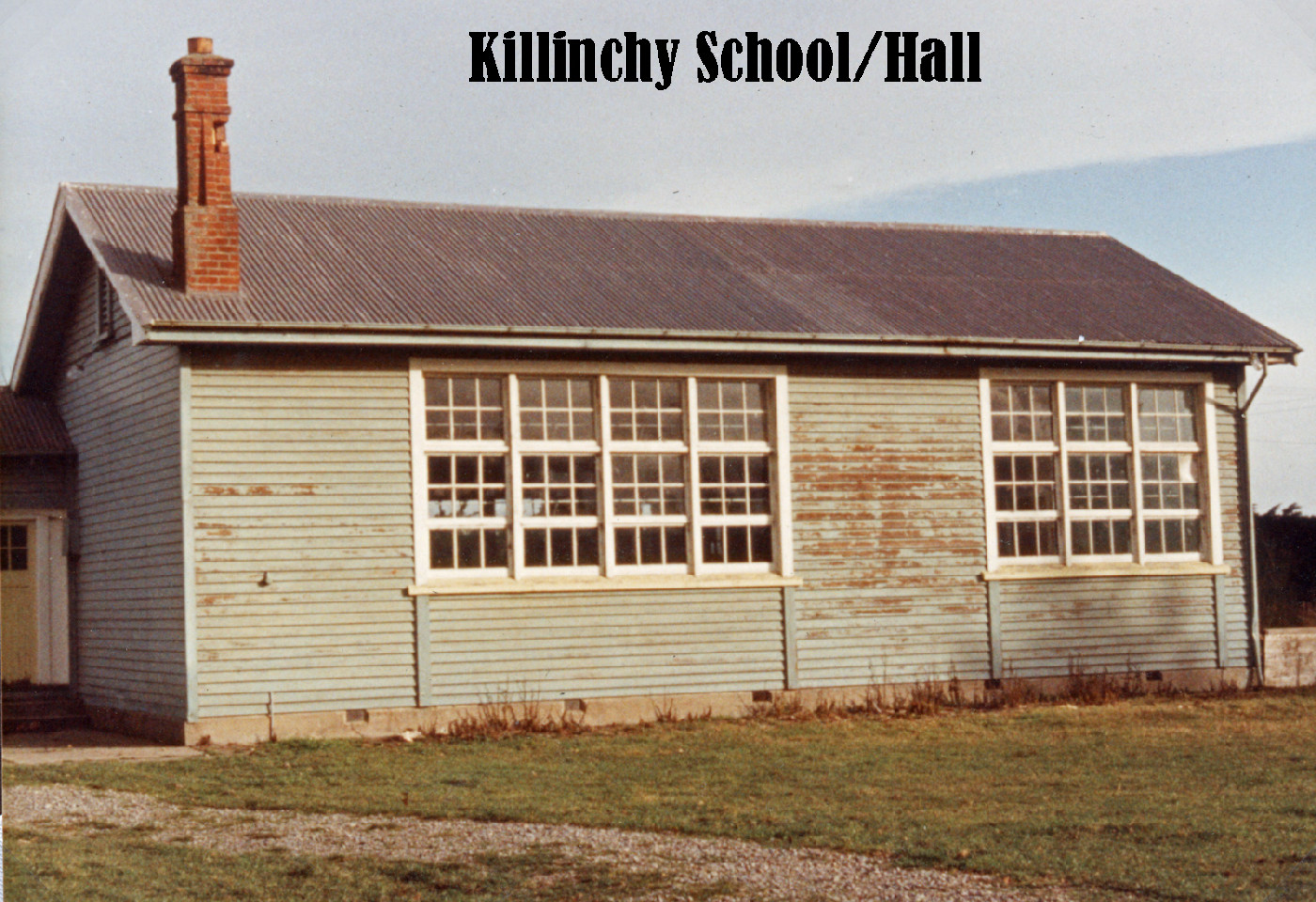
As you can see from the photo that Allan Chapman took, the school needed a coat of paint - desperately.
Originally there was a fire in each classroom and you can see in the photo that there is only one chimney.
We took one down, but because it was built so strongly and lined all the way up, we struggled. It was a damp day, the roof was slippery and we were glad Health & Safety did not visit us.
Of course, being a dual committee we ran the old hall as well, which was behind the oak trees north of the school and that was run as a separate entity and the land comes under a separate title.
The rifle club finished up with it in the end; looking after it. It was left to them in 1966.
That hall was deemed to have the best dance floor in the district – it was a beautiful floor; of course, as the years went on, the building got beyond the Rifle Club and the community looking after it; so it was decided it had to go and the Rifle Club folded and that was that.
But I must say - my son has a window frame out of that old building.
I never knew what he thought he was going to do with it but I think he’s still got it; it was one of those beautiful windows - oval shaped at the top; four little panes of glass; beautiful frame; there wasn’t many of those panes of glass left in it when he got it but he’s got it tucked away somewhere for old times’ sake, I suppose.
Of course when we were struggling for finance and one thing and another to keep us going; the Council came along with their ideas to take over the financing part of it; look after our money and we had to put a rate on all householders.
So we started off at $10.00; $10.00 was the minimum rate; so we thought we were made then; we really had some money that we could spend and that kept us going ‘til we see today.
Then in 1980 we became the Killinchy Community Centre; before that we were just the Hall Committee.
Then in 1995, that’s when we came into negotiations with the Tennis Club wanting to come and join us and build their tennis courts in the school grounds and from then on as you can see things have moved on quite rapidly.
The old hall was pulled down in 1990 and cleared and all grassed and made it like it is today – it’s a credit to the ones that keep it tidy now; it used to grow a fair bit of grass and rubbish but it’s very good now.
And of course the Tennis Club came down here in 1995 and as you can see they have done a lot of work since then together with the community. They’ve opened up the side facing the tennis courts with French doors.
I am very proud of the community who have carried on and kept it as it is today.
(Editor’s note: Murray was Chairman from 1966-1988 (32 years) and Sam Boal was Secretary from 1969-1994 (25 years). Both these men, and many other people, have demonstrated the tremendous amount of community spirit that existed in the Ellesmere District.)
Adapted from a talk given by Murray Boon.
Ellesmere Historical Society
By Murray Boon, Ellesmere Historical Society. First published in The Ellesmere Echo, 11 & 25 November 2021. Reproduced from Selwyn Stories under CC BY-NC 3.0 NZ.
The Killinchy Tennis Club relocates to the Killinchy School site By Sandra Opie · researched by Sandra Opie & Mike Noonan · The Ellesmere Echo, 16 December 2021 Read ▾
Around 1995 when the Killinchy Tennis Club first decided to relocate their courts to the Community Centre; a proposed plan and costings to renovate the hall was put forward to the Hall Committee.
This refurbished building would then be able to serve the tennis club well as a much-needed club room facility; together with an updated community hall that the district’s members could use for social gatherings and other community events.
Once an agreement had been reached and final draft plans were approved; tenders were put out to local builders.
A large veranda on the east side of the building was added together with French doors which led straight into the hall rather than the old entrance through the porch area.
Sun and wind shades were added to the veranda to accommodate an indoor-outdoor flow and a sail was put up over the barbeque area which set for an idyllic tennis club setting and a fabulous place to celebrate many occasions.
The 1997 celebrations for past school pupils and the tennis club’s 75th anniversary was a perfect time to bring everyone together to reunite and celebrate the new look of these grounds.
At this time also, members of the community together with tennis club members joined forces to bring the community pool back to life.
This proved a very worthwhile effort as so many children have enjoyed the waters of this pool every year since.
Community members have taken on this voluntary role of supervising all areas associated with the swimming season.
A huge project of clearing the site where the old hall sat and sowing grass to create more picnic area space and parking was achieved. Alder trees and natives were planted to give shelter along the northern end.
Over time; with new committee members coming and going; both men’s and women’s toilets in the hall have been upgraded, another set of curtains made and the kitchen can boast two updates!
Earthquake damage to the open fireplace meant that this has now been replaced with a log burner and most recently, heat pumps have been installed.
A playground was added to the site in 2001 which created a wonderful addition to this area for small children to play.
A submersible pump was generously donated and a well was drilled to give the community hall its own water supply rather than sharing with the adjoining schoolhouse that had been sold to private owners.
The swimming pool has now had the old fence taken down and a nice new iron fence erected around it.
A new updated pump system was installed, more concrete poured to save mowing, and a lovely bright sail over the picnic area together with an upgrade of the changing sheds all brought new life back into these old and tired facilities.
These projects, including the pea-straw baling and carting (to help with the finance), were all completed by enthusiastic Killinchy community and tennis club members who enjoyed very much the comradeship of getting together on these occasions to complete the many tasks at the community centre.
At this present time, the facility is extremely well used by the tennis club and community pool users every summer; and, on many occasions throughout the year, hosting private and community events.
The asset these community people have created and the passion they have had must auger well for the future generations of Killinchy to come.
Sandra Opie & Mike Noonan
Ellesmere Historical Society
By Sandra Opie · researched by Sandra Opie & Mike Noonan, Ellesmere Historical Society. First published in The Ellesmere Echo, 16 December 2021. Reproduced from Selwyn Stories under CC BY-NC 3.0 NZ.
Have memories, stories or records to share? We would love to hear from you.
Get in touch